Passages (2023), directed by Ira Sachs, is an intimate and provocative drama that dissects the nature of love, desire, and identity through the story of a toxic love triangle in modern Paris. It’s a film about people who crave connection but are trapped by their own selfishness and confusion — a portrait of emotional chaos that feels as raw as it is honest.

The story follows Tomas (Franz Rogowski), a restless German filmmaker living in Paris, and his husband Martin (Ben Whishaw), a gentle British printer. Their marriage, while long and seemingly stable, has become routine — filled with affection but lacking excitement. During the wrap party for his new film, Tomas meets Agathe (Adèle Exarchopoulos), a young French woman whose warmth and openness spark something inside him. What begins as a spontaneous sexual encounter quickly turns into a passionate affair that disrupts the quiet balance of his life.
When Tomas confesses to Martin that he slept with a woman, he does so without remorse — almost as if seeking validation for his impulsive decision. But his confession sets off a chain reaction of hurt and confusion. Tomas moves in with Agathe, chasing the thrill of newness, while Martin is left to rebuild his life after betrayal. Yet, despite his attempt to move on, Tomas cannot let go of Martin. He drifts back and forth between the two, unable to choose, needing both the stability Martin offers and the vitality Agathe brings.
As the film unfolds, Passages becomes less about infidelity and more about narcissism, control, and the desperate search for identity. Tomas is both magnetic and destructive — a man who uses love as a mirror for his ego, incapable of seeing the emotional wreckage he leaves behind. His relationships with both Martin and Agathe expose his inability to love selflessly; he demands intimacy but fears commitment, he craves freedom but cannot stand being alone.
Meanwhile, Martin’s quiet strength contrasts sharply with Tomas’s volatility. Though deeply hurt, he remains dignified, embodying the kind of love that endures even when it cannot survive. Agathe, too, undergoes her own transformation — from infatuated lover to a woman who realizes that her affection for Tomas will only consume her. When she discovers she is pregnant, the situation reaches its emotional peak. Her decision — whether to keep the baby or not — becomes symbolic of her need to reclaim control over her own life, breaking free from the emotional triangle that has trapped her.
Sachs directs the film with extraordinary subtlety and patience. Every glance, pause, and silence feels loaded with unspoken emotion. The Paris setting adds a natural intimacy — apartments, cafés, and narrow streets become stages for confrontation and reconciliation. The cinematography captures both the beauty and suffocation of modern relationships: close, physical, yet emotionally distant.
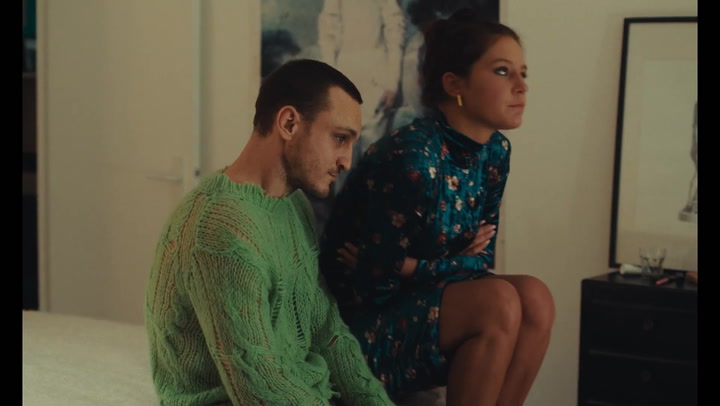
The performances are fearless. Franz Rogowski embodies Tomas with a blend of charm and cruelty — magnetic but impossible to trust. Ben Whishaw’s Martin is heartbreakingly vulnerable, his quiet sadness radiating through every scene. Adèle Exarchopoulos brings warmth and sensitivity, grounding the story in human reality even as it spirals toward despair.
By the end, there are no easy resolutions. Tomas loses both lovers; Agathe chooses independence; Martin moves on. The cycle of desire collapses, leaving Tomas facing the emptiness of his own choices. Passages does not moralize — it simply observes, asking whether love can exist when self-interest overshadows empathy, and whether desire can ever truly be shared without destroying someone in the process.
Ultimately, Passages is not about romance — it’s about how love and ego collide, how people mistake passion for connection, and how self-awareness often arrives too late. It’s tender, brutal, and beautifully uncomfortable — a film that captures the messy, human truth that every love story is also a story of loss.
