That Man from Rio (original title: L’Homme de Rio) is a 1964 French adventure comedy directed by Philippe de Broca, starring Jean-Paul Belmondo and Françoise Dorléac. Blending humor, romance, and thrilling escapades, the film pays playful tribute to pulp adventure stories and Hollywood serials of the 1930s while establishing its own lively, distinctly French charm.
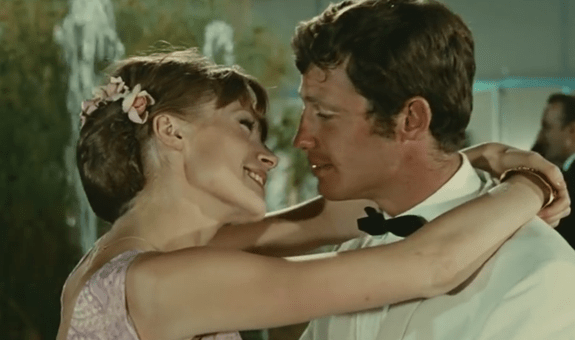
The story follows Adrien Dufourquet, a young French airman on a short leave in Paris. He is excited to reunite with his fiancée, Agnès Villermosa, but before they can enjoy their time together, she is suddenly kidnapped in broad daylight by mysterious men. Adrien quickly discovers that her abduction is connected to the theft of a priceless Amazonian statue from a museum — one of three ancient idols that, when united, are said to reveal a hidden treasure.
Without hesitation and armed only with his impulsive courage, Adrien launches himself into a wild chase that takes him all the way to Brazil — first to Rio de Janeiro and then deep into the Amazon jungle. What follows is a series of fast-paced, often hilarious adventures filled with narrow escapes, mistaken identities, and colorful characters. Whether hanging from moving cars, escaping from villains, or diving headfirst into chaos, Adrien’s determination to save Agnès keeps him moving forward at full speed.
Throughout the film, the tone remains light and playful, mixing romance and action with a comic sensibility. Adrien’s recklessness contrasts beautifully with Agnès’s quick wit and independent spirit. Their chemistry gives the story both warmth and humor — a romantic dynamic where affection and frustration constantly collide.
Director Philippe de Broca uses breathtaking locations in Rio and the Amazon to full effect. The film’s bright color palette, lively camera work, and inventive stunts make it visually thrilling. It was shot largely on location, which adds authenticity and vibrancy — from the bustling streets of Rio Carnival to the lush, mysterious rainforests of South America. The adventurous atmosphere feels both exotic and joyful, giving the audience a sense of travel, discovery, and youthful freedom.
Jean-Paul Belmondo, at the height of his career, performs nearly all his own stunts, bringing physical comedy and charisma to every scene. His Adrien is part hero, part clown — brave, spontaneous, and endlessly charming. Françoise Dorléac gives Agnès a spirited and mischievous edge, refusing to be just a damsel in distress; she matches Adrien’s energy with her own intelligence and determination. Together, they turn a standard adventure plot into something irresistibly human and funny.

Beneath the humor and chaos, That Man from Rio also captures a sense of the 1960s’ optimism — a world fascinated by travel, discovery, and cinematic escapism. It celebrates the thrill of adventure for adventure’s sake, but it also pokes fun at the absurdity of heroism itself. Every twist and chase is exaggerated, playful, and self-aware, as if the film is winking at its own clichés.
The pacing never slows. De Broca keeps the action brisk and the tone light, balancing slapstick moments with clever dialogue and moments of genuine emotion. The score by Georges Delerue adds to the film’s energy — bright, whimsical, and full of momentum, perfectly matching Adrien’s frantic journey across continents.
By the end, That Man from Rio delivers a satisfying mix of laughter, romance, and suspense. The mystery of the statues is resolved in a way that underscores the absurdity of greed and the futility of obsession, while Adrien and Agnès’s relationship reaffirms the film’s emotional core: that love, adventure, and laughter often come hand in hand.
